
Business
Popular baby monitoring company Owlet warns parents after child dies from loose camera cable
By Marcus Chen
Advertisement · Why this ad?
Marcus manages the day-to-day editorial workflow across all brands, coordinating coverage assignments and ensuring editorial standards are met. He previously served as city editor at the Pioneer Press and holds a degree in Political Science from Carleton College.
More from Marcus →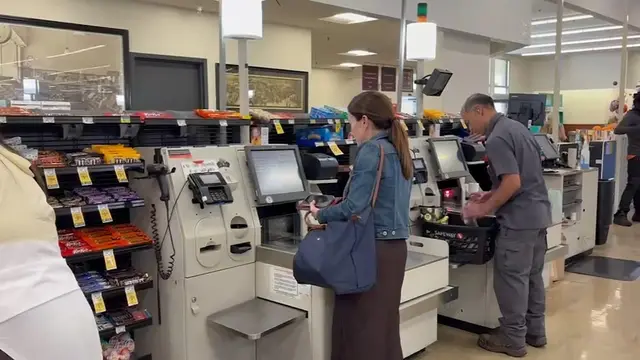
The familiar beep of a self-checkout scanner, once a symbol of convenience, is now the subject of intense debate in San Francisco. At one Safeway store, a single attendant struggled to manage over ten self-checkout stations while security personnel intervened in a customer dispute – a scene that has prompted a city-wide proposal to regulate these increasingly common fixtures in grocery stores and pharmacies. San Francisco Board of Supervisors President Rafael Mandelman is spearheading an effort that would require one employee for every three self-checkout stations, aiming to improve customer service, curb theft, and safeguard retail jobs.
The proposed ordinance, currently under consideration by city officials, seeks to address concerns about the impact of self-checkout technology on both customers and the workforce. Mandelman’s plan isn't about eliminating self-checkout altogether; rather, it aims to limit the burden on individual employees by capping their responsibility to no more than three stations. This initiative is rooted in a broader anxiety over declining retail employment, highlighted by a U.S. Bureau of Labor Statistics report projecting a 6% nationwide decline in retail cashiers over the next decade, potentially costing approximately 200,000 jobs. “The reduction of clerks in these stores is not something we can stop but we would like to save some of these jobs,” Mandelman stated.
The push for regulation isn't unique to San Francisco. Similar measures have been debated in Sacramento and considered in San Jose. In fact, four California cities have already enacted self-checkout rules, demonstrating a growing trend among local governments to address concerns related to job displacement and theft. However, the proposal hasn't been universally welcomed, with business groups raising alarms about potential cost increases for retailers already operating on tight margins. Nate Rose of the California Grocers Association warned that increased costs could lead to higher prices for consumers or, as seen in Long Beach, the complete removal of self-checkout stations. Ten stores in Long Beach eliminated self-checkout after their city’s ordinance took effect in 2025, citing enforcement challenges.
United Food and Commercial Workers Local 5 representative James Araby dismissed the argument that the proposal would force stores to abandon self-checkout altogether. “You're telling me you can't pay one person, one additional person upfront?” he questioned, accusing opponents of attempting to shift blame onto unions. The debate underscores a complex tension between technological advancement, economic realities, and the desire to preserve traditional jobs in the retail sector. U.S. Bureau of Labor Statistics provides detailed data on employment trends across various sectors.
Customer sentiment is also divided. San Francisco resident Tony Ramos expressed skepticism about the proposal, arguing that the city has more pressing priorities. “Too much in their business. I don't care what they do. I feel like there are other priorities in the city that should have regulations, should have this attention as opposed to what happens at Whole Foods,” he said. Conversely, Elyze Stewart voiced support, believing it could reduce theft and create jobs. “If it makes it easier to not have stealing going on to have two people working, then I would support it. I mean jobs for as many people as possible is what I would say,” she explained.
Beyond staffing requirements, the proposal also includes a limit of 15 items per self-checkout transaction. Mandelman emphasized the importance of increased supervision in stores, arguing that it benefits not only retailers but also the broader community by deterring theft. “More eyes in the store is a good thing and the impacts of retail theft are not just on the retailer itself, it’s also on the community and on the surrounding businesses,” he said. The San Francisco Chamber of Commerce has questioned the necessity of the proposal, citing declining theft rates at self-checkout stations and restrictions on employees confronting suspected shoplifters. The San Francisco Chamber of Commerce represents businesses across the city.
Some retailers have already implemented preventative measures, such as requiring customers to scan receipts to open electronic exit gates and conducting random receipt checks. These proactive steps suggest a growing awareness of the challenges associated with self-checkout and the need for enhanced security. Enforcement of the proposed regulations, should they be approved, would be handled by the Office of Labor Standards Enforcement and the San Francisco City Attorney’s Office. The City and County of San Francisco website provides information on local government services and ordinances.
The proposed regulations come amid a broader decline in retail employment. According to the U.S. Bureau of Labor Statistics, the number of retail cashiers has fallen since 2019, and projections indicate a 6% decline nationwide over the next decade, potentially resulting in the loss of approximately 200,000 jobs. This trend has fueled concerns about job displacement and the need to support retail workers during a period of technological transition.
The potential impact of self-checkout regulations has been highlighted by the experience in Long Beach, California. Following the implementation of a similar ordinance in 2025, ten stores in the city removed self-checkout stations, citing concerns about how the law was being interpreted and enforced. This outcome has prompted business groups to caution against overly restrictive regulations that could lead to unintended consequences.
Rafael Mandelman, San Francisco Board of Supervisors President: “The reduction of clerks in these stores is not something we can stop but we would like to save some of these jobs.”
James Araby, United Food and Commercial Workers Local 5: “You're telling me you can't pay one person, one additional person upfront?”
Nate Rose, California Grocers Association: “When you start to change the math there, its going to have to come from somewhere and unfortunately that’s probably going to be higher prices on grocery store shelves or as we’ve seen in other cities like Long Beach grocers will just close self-checkout all together.”
David Harrison, Director of Public Policy for the SF Chamber of Commerce: “Typically, the self-checkout has cameras and I think we’ve all been through an experience even if you’re not putting an item in the right place, that there is going to have to be a human that trouble shoots.”
The San Francisco Board of Supervisors will continue to review the proposal and consider public feedback. The outcome remains uncertain, but the debate is likely to continue as cities grapple with the evolving role of self-checkout technology in the retail sector. Residents can follow the progress of the proposal on the San Francisco government website and engage with their elected officials to voice their opinions.
United Food and Commercial Workers Local 5: https://www.ufcw5.org/ - Represents retail workers and advocates for fair labor practices.
California Grocers Association: California Grocers Association - Represents grocery retailers and promotes a thriving food industry.
San Francisco Chamber of Commerce: https://sfchamber.com/ - Advocates for business interests and supports economic growth in San Francisco.
The future of self-checkout in San Francisco, and potentially in other cities across California, hinges on balancing the desire for efficiency with the need to protect jobs and maintain a positive customer experience. The coming months will reveal whether this proposal strikes that balance or if it ultimately proves to be a costly and ineffective solution.
Woodside, California
Business
Saturday, November 14, 2026
6 min
By Marcus Chen

By Marcus Chen

By Katherine Langford

By Marcus Chen